


As an early-stage consumer investor, my #1 question to founders almost always regards defensibility. It’s easy to get distracted by the bells and whistles of consumer companies (related: The Value of a Velvet Rope), so I’ve found that returning to first principles keeps me grounded when making investment decisions and thinking about early-stage businesses.
As such, I wanted to share this four-part framework more broadly in case it is helpful to other consumer founders:
Why do people come? Why do people stay? Why do people share? Why do people pay?
1. Why do people come?
What gets users on the platform? Can this be distilled down to a single sentence? Who is your (precise) customer, and what do they want?
Related: Is Your Product a Vitamin or Painkiller?
Also related: How the biggest consumer apps got their first 1,000 users

2. Why do people stay?
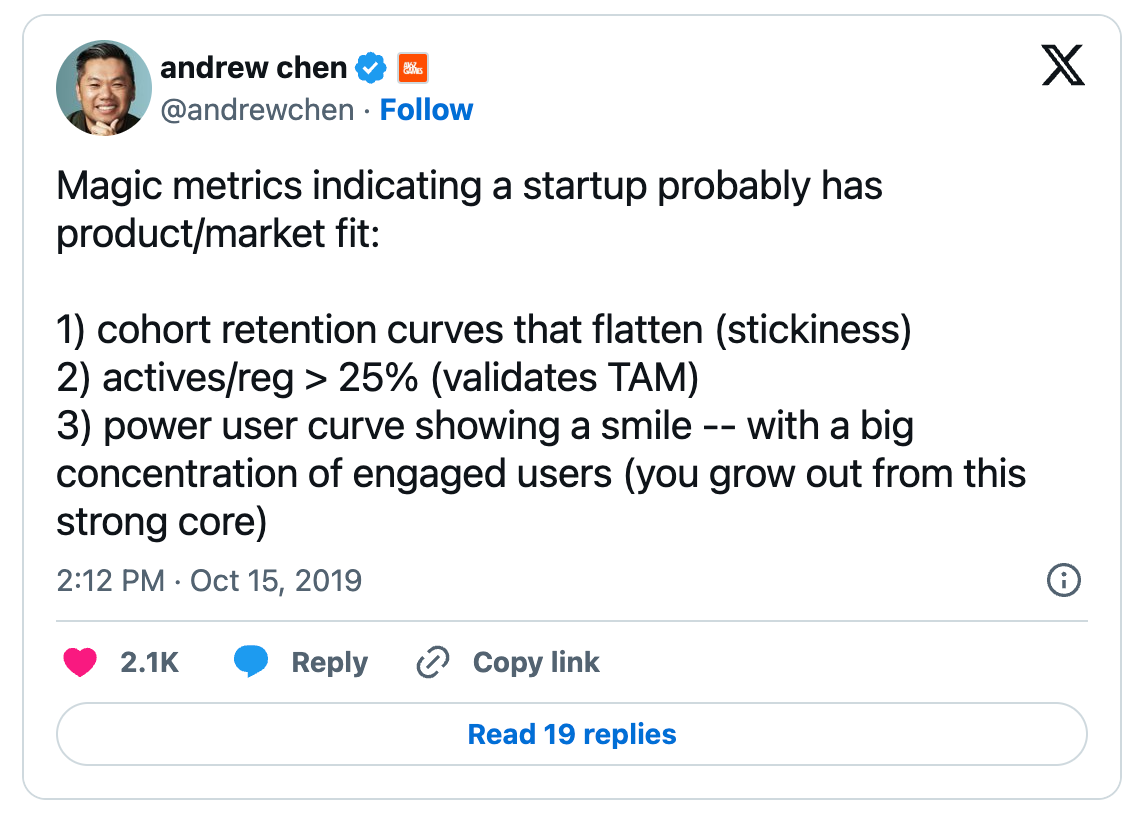
This question is all about user retention. In consumer businesses, frequency and time spent are key. What are the features or actions that receive the most user engagement? What are the switching costs? Is there lock-in?
When looking at cohort retention, is the absolute size of the cohort growing? How does behavior change as cohorts grow? Do cohorts stabilize, and if so, when? Do newer cohorts perform the same, better, or worse than older ones?
Related: What is good retention?
3. Why do people share?
Is there a propensity to share the product or platform via social media or word of mouth? A key concept here is virality, when a product spreads from one user to another through direct customer to customer contact.

4. Why do people pay?
Consumer businesses typically fall under one of three categories:
Marketplaces: facilitating transactions between buyers and sellers (think Airbnb, Stubhub, Hipcamp)
Platforms: usually free UGC media/content platforms with indirect monetization (think Pinterest, Twitch)
Products & Services: consumers pay for something the company produces (think Peloton, Spotify)
How will economics change over time? What drives differentiation — price, service, brand? Is it sustainable and defensible?
Related: This podcast with Patrick OShaughnessy and Turner Novak that touches on monetization models for consumer social
I’m still early in my own career as an investor, and I learn more every day. If you’re working on a startup yourself, please push me on this framework! How does it apply to your own business; e.g., How would you answer these questions? Are there edge cases where this framework breaks down or leaves something out? I look forward to hearing your thoughts.
Note: Special thanks to Zack Hargett of Scout, who helped me develop this framework during a product jam session back in 2020.